Build story
Puzzably: AI gallery walls you assemble yourself
The problem
Wall art is a commodity and puzzles are a commodity, but a set of puzzles designed as one cohesive gallery wall, generated from your own idea, is neither. The interesting challenge was operational: can one person run a physical-goods business where the product is generated per order?
What I built
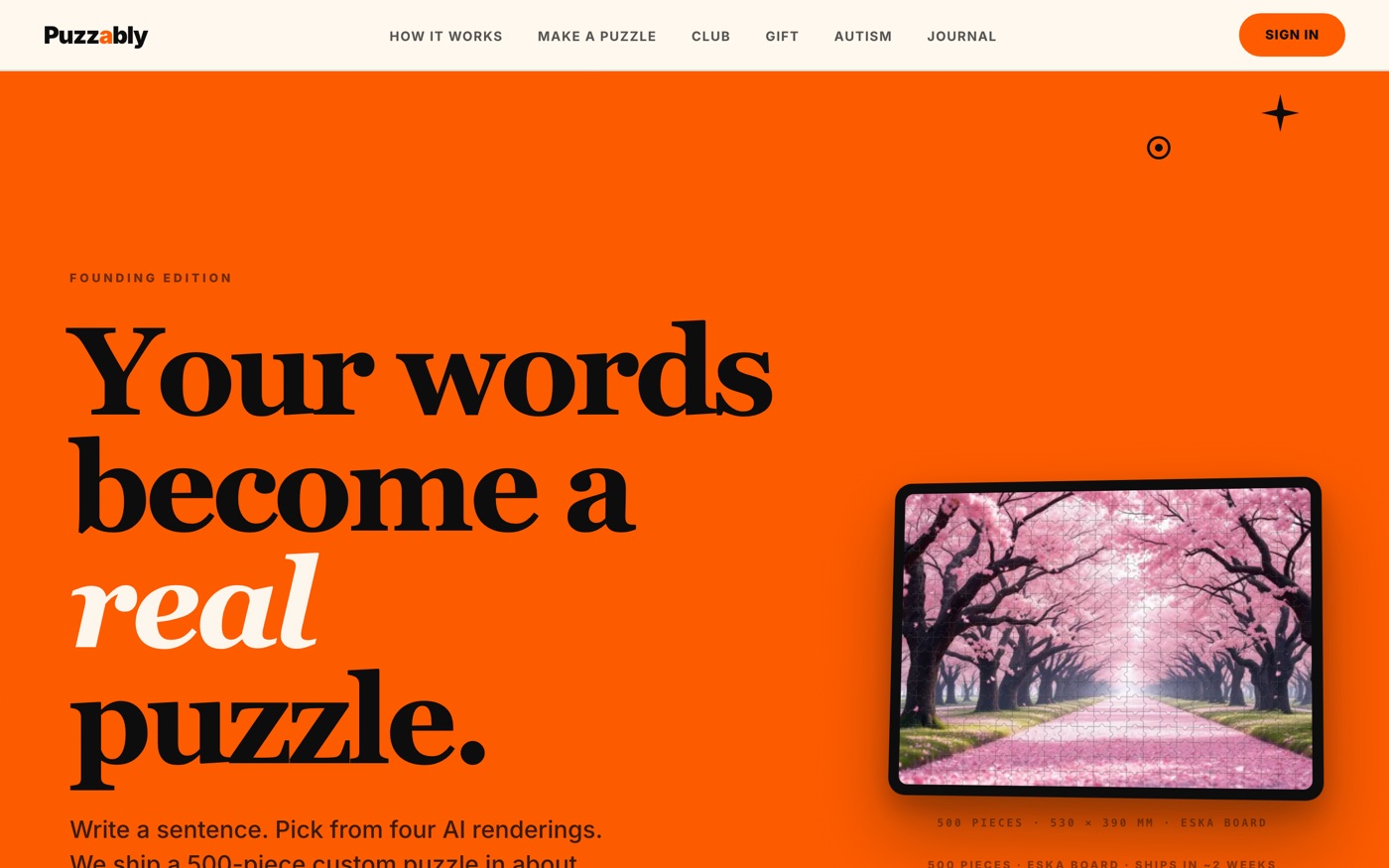
Puzzably turns any room into a gallery. You describe a visual world, AI generates a cohesive set of 3, 6, or 9 five-hundred-piece jigsaw puzzles designed to hang together as wall art. Each set is printed on museum-grade ESKA board and ships within 7 business days.
It is live, end to end: studio flow for designing your set, Stripe checkout, automated print fulfillment, and transactional email.
How it works
- Next.js 14 App Router monorepo: marketing site, design studio, and order dashboard in one app, with a separate brand package holding tokens, logos, and a copy bank.
- A generation pipeline tuned for cohesion: the hard problem is making a 6-puzzle wall read as one body of work, not six random images. Getting there took real iteration; the recipe stays in the kitchen.
- Physical fulfillment, hands off: payment kicks off print and shipping automatically, webhooks drive order state, and customers get transactional email at every step.
- Supabase for auth, orders, and migrations; every environment variable validated at startup.
- Ops as docs: the repo carries deploy and operations runbooks written so a non-developer could run the business. Writing them taught me more about the business than the code did.
What I’m learning
Puzzably is my education in physical goods: the code is the easy half. Print tolerances, fulfillment SLAs, refund flows, and the gap between “image looks good on screen” and “image looks good as 500 die-cut pieces” all had to be learned by shipping. It is also my testbed for programmatic SEO, with content and landing pages generated from the same product data.